
TL;DR
All Things Gwinnett had a useful story for its 40,000-plus Facebook members and one evening to report it. At 285 Marketing, we used ChatGPT to research the businesses, then deployed two AI agents to call locations where the published information fell short. The agents placed 18 calls to 17 businesses. I set the priorities, resolved conflicting information, and decided what went into the guide.

The Wednesday before Thanksgiving, I had a Thanksgiving guide I wanted to publish for All Things Gwinnett and about eight hours of research I thought it would take to get it right. I run both All Things Gwinnett and 285 Marketing. As the publisher, I knew what our readers would want to know by morning. As the agency owner, I wanted to figure out how much of that reporting I could hand off while I kept working on the website.
Writing the article was the easy assignment. The harder one was specific: find out which Gwinnett restaurants and grocery stores would open on Thanksgiving, at which locations, and for what hours. A business could have a website, an active Facebook page, and a complete Google Maps listing and still leave that question unanswered.
We built the workflow around those missing answers. ChatGPT helped research the initial list. Muse and GrokBot handled phone calls. I made the editorial decisions. The most useful thing 285 Marketing did for All Things Gwinnett was decide when each of us needed to get involved.
The content strategy started with a decision readers had to make
Someone looking for Thanksgiving dinner has a pretty practical question: If I take my family there at four, can we eat? “Open Thanksgiving” sounds like an answer until you learn that the restaurant closes between lunch and dinner.
That shaped both the angle and the research. I wanted All Things Gwinnett to cover local restaurants and Asian supermarkets I knew from living here, including places residents might overlook. For each recommendation, we needed the specific branch, what it offered that day, and whatever holiday hours we could support. A supermarket’s opening hours wouldn’t tell us whether the independent vendors in its food court were serving. A restaurant’s normal closing time wouldn’t tell us when it planned to take its last Thanksgiving order.
Those distinctions helped us decide where to spend time. If a local outlet had already published a restaurant’s Thanksgiving buffet schedule, we could use that reporting and credit the source. If the only thing online was a normal Thursday listing, we still had a reporting assignment.
How we turned a spreadsheet into a call list
We used ChatGPT to help check business websites, Google Maps, social posts, and coverage from local outlets and blogs. I wanted multiple sources wherever we could find them. I also wanted to know what each source actually established.
McCray’s Tavern is a good example. Google Maps listed hours of 11 a.m. to 7 p.m. FOX 5 reported that its Thanksgiving buffet ran from 11 a.m. to 5:30 p.m. Those times could both be accurate. Our reader wanted to know when they could get the buffet, so I told Muse to use the holiday-specific reporting. At Kroger, sources disagreed about closing time. I passed on the call because I wanted to spend our limited calls on businesses closer to the focus of the story.
By the time Muse received the research workbook, it had 90 rows across four tabs: restaurants, groceries, food courts, and Black Friday. Each row carried the location, the available contact information, what we knew, and where the information came from.
My first instruction to Muse was to call every establishment. That was too broad. Some rows already had usable answers. One entire tab concerned Friday. And Muse had a budget of 20 calls. Once I saw the scope, I changed the assignment:
“we only have 20 calls. So we need to be selective. We only want to confirm restaurants and grocery stores that aren't verified. Find the top 20 to call”
Muse found 34 unverified restaurant and grocery candidates and created a “Top 20 Calls” tab. Now it had a job I could leave it to do. It knew which businesses qualified, what question to ask, how many calls it could spend, and where the answers belonged.
The workflow from research to publication
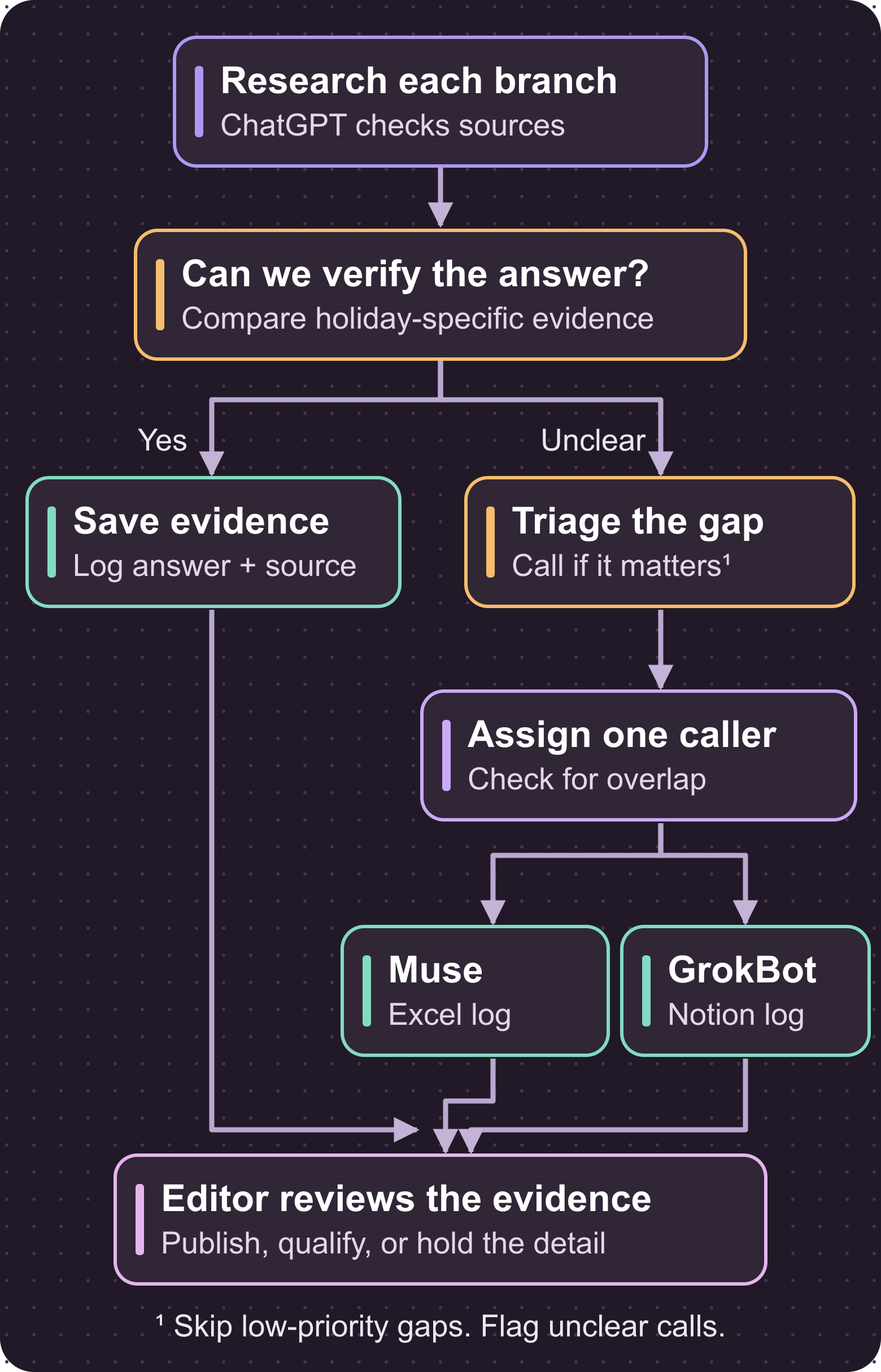
How we deployed two calling agents without doubling up the work
Muse worked primarily from Excel. It checked the phone numbers, made the calls, and recorded results in both the business’s original row and the priority tab. GrokBot worked from a shared Notion call desk that held venue assignments and research notes. Before dialing, GrokBot spotted that three restaurants on its seven-restaurant list were already covered by another caller. It dropped those three and sorted the remaining four by closing time.
That little bit of coordination mattered. These restaurants were getting ready for a holiday. The last thing I wanted was for two agents working on the same article to call the same host five minutes apart.
I shortened GrokBot’s opener to “Just ask if they're open for thanksgiving.” If the employee said yes, the follow-up was when they opened and closed. We had no reservation to make. At Hong Kong Supermarket in Norcross, an employee told Muse, “We open from nine to ten.” Muse asked whether that meant 9 a.m. to 10 p.m. The employee confirmed it. That extra question gave us an answer we could use.
The deployment also had to account for a limit we discovered that evening. Muse could make only five calls in an hour. After its first five, I directed it to check which restaurants would still be open around 9 p.m. and schedule those for its next batch. GrokBot made calls during the gap. Meanwhile, I was using other agents to build parts of the website and watching football.
What the calls added to the finished article
Royal China in Duluth gave us the clearest example of why the phone work was worth doing. When Muse asked about Thanksgiving hours, the employee answered:
“Be open ten to three, five thirty to nine thirty tomorrow.”
That one sentence changed how we could write the listing. A family could eat there at 2:30 or 6. Showing up at 4 meant waiting an hour and a half for dinner service. That’s exactly the detail somebody wants from a local publication.
ASSI Market, Suwanee. Its regular listing showed a 9 p.m. close. An employee gave Muse Thanksgiving hours of 9 a.m. to 6 p.m. We used the holiday hours supplied by the store.
Phở Đại Lợi #3, Duluth. Maps showed a regular 9 p.m. close. Staff told GrokBot “nine to five” for Thanksgiving. We had a closing time. The kitchen’s last order remained unknown.
China Cafe, Grayson. The first call dropped. On the retry, GrokBot heard what sounded like a one-hour opening window. It documented what it heard and flagged the hours for another check.
Great Wall Supermarket, Duluth. The call ended before Muse got an answer. We had the store’s holiday-week circular. The guide identified the hours as advertised in the circular and suggested calling before a late trip.
Those source notes helped when it came time to write. “An employee confirmed,” “the store advertised,” and “we couldn’t verify” give a reader different reasons to trust a detail. Keeping that information attached to each location meant we could carry it into the copy. Readers also got the addresses, phone numbers, and directions they needed to act on the reporting.
Read the published All Things Gwinnett guide
What the workflow saved, and where it broke
Muse dialed 10 locations. GrokBot placed eight calls to seven locations, including its retry at China Cafe. Between them, the agents placed 18 calls to 17 businesses on Wednesday evening. GrokBot’s calling window was about 13 minutes. About 77 minutes elapsed between Muse’s first and last dials because of its hourly limit.
While the agents made calls and logged the answers, I kept working on the All Things Gwinnett website. I could check the notes when a source disagreed or a call left a question open.
Thursday morning showed me what I’d change. Muse’s scheduled batches failed before they dialed. GrokBot had two morning calls scheduled, but their approval requests expired. Neither agent reached a business that morning.
Next time, I’d have one shared call log that distinguishes scheduled, dialed, and answered, and I’d check it after the first scheduled morning call. On Wednesday night, I could adjust the script or switch assignments while businesses were still open. By Thursday morning, a missed call had already cost us some of the time the article was useful.
How to use this workflow for your own business
If you’re looking for content ideas, think about the last question a customer asked that made you say, “I know a few places. Let me check and get back to you.” There’s probably an article in whatever you had to look up.
Photography is another business I know. Say a couple asks where they can hold a small weekday wedding with a guaranteed indoor option if it rains. I could name venues I’d recommend. It would still take work to figure out whether the indoor space in each venue’s photos comes with its weekday package.
I’d give an agent my shortlist and have it check the package details on each venue’s site. If the policy is clear, save the link. If there’s a photo of an indoor ceremony and no mention of who gets to use the room, that venue gets one phone question: “If a couple books your small weekday package and it rains, do they have a guaranteed indoor ceremony space?” I could then spend my writing time on the advice that comes from being a photographer, with the venue policies already in front of me.
Here’s the assignment I’d give an agent:
I’m putting together [resource] for customers who need to decide [specific question]. Start with [businesses or sources]. For each one, record the answer, the source, and anything still unclear in [shared sheet].
Recommend which gaps are worth a call and give me the question you’d ask. Once I approve the list, make up to [number] calls during business hours. Record whether each call connected and what the person said. Flag anything I need to decide before we publish.
That’s the kind of project we can help you build at 285 Marketing. Bring us a customer question you’d like to turn into a useful piece of content, or a recurring research job you keep putting off. We can start with the work already sitting on your list.
Explore AI transformation at 285 Marketing

Michael Yang
Michael Yang is the founder of 285 Marketing. He helps Gwinnett small businesses get found through SEO and AI search, build better websites, and turn local attention into customers. His experience spans enterprise marketing and hands-on work with local businesses.
More from this author →